


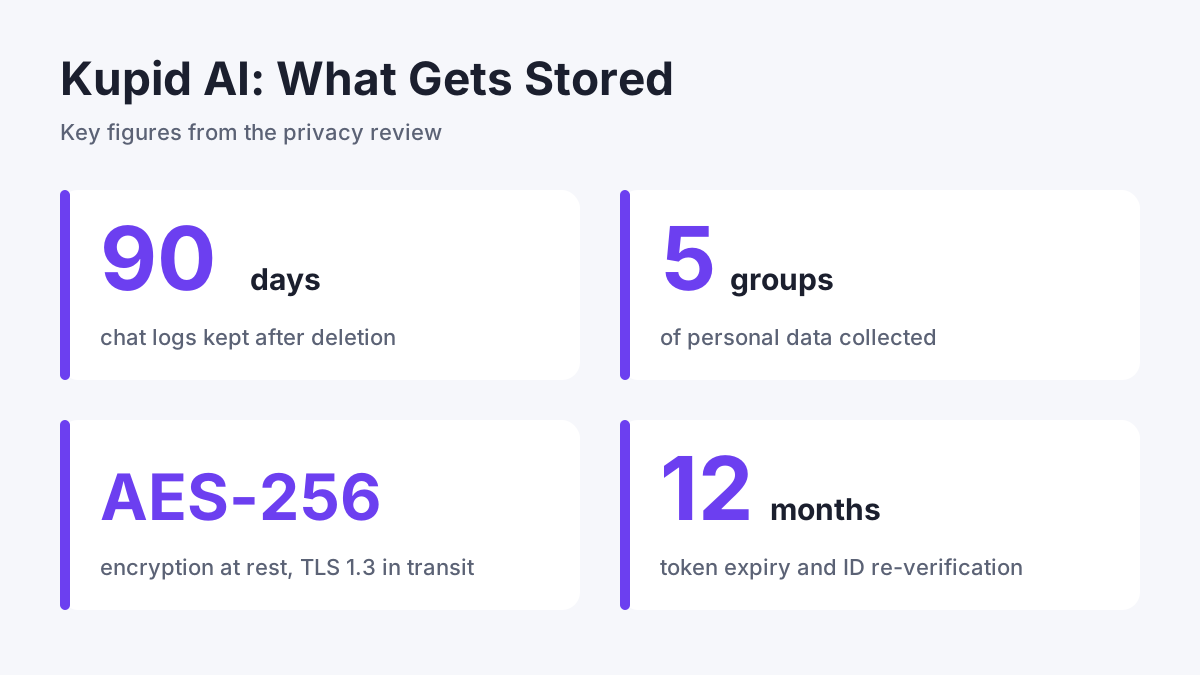
Kupid AI keeps chat logs for 90 days after you delete your account, according to the information on file for this service. That one figure tells you more than any slogan about private conversations. Before you type a word to an AI girlfriend, you should know what the service stores, for how long, and who else can see it.
This guide separates what is confirmed from what the provider claims. Where something cannot be checked from the outside, it is marked as unverified. Noted.
What personal data Kupid AI collects
The data falls into five groups. First, profile information: your age, gender and interests, which feed the personality of your AI companion. Second, chat logs, meaning every message you send and every reply you receive. Third, voice recordings, if you use voice messages. Fourth, image prompts, the text descriptions you submit when you ask for generated pictures. Fifth, payment data, which is passed to a third-party processor rather than stored by the app itself.
Chat logs are the sensitive part. People tell an AI companion things they would not post anywhere else: loneliness, relationship history, health worries, sexual preferences. A log of that is not ordinary account data. If the log leaks, it cannot be reset like a password.
Voice recordings deserve a separate note. A voice is a biometric-adjacent identifier, and a recording can be replayed years later. If you do not need voice messages, do not switch them on. Text carries less risk, and you lose very little by skipping the microphone.
Retention: how long your data stays
Per the terms summarised in our research, chat logs are retained for 90 days after account deletion. Anonymised analytics are kept indefinitely. Those are two different promises, and only the first one is bounded.

Anonymised data is not automatically harmless. Stripping a name from a chat does not always stop a person being recognised, especially when the text mentions a workplace, a town or a distinctive event. Treat any "anonymised" claim as unverified until the policy explains the method used.
Tokens are a separate matter. The token system reportedly expires after 12 months of inactivity, so unused credit can disappear. That affects your wallet, not your privacy, but it is worth knowing before you buy a large pack and walk away from the app.
How the data is said to be protected
The provider's stated measures are AES-256 encryption at rest and TLS 1.3 in transit, with data held on GDPR-compliant servers in the EU and the US. Those are reasonable standards on paper. They are also unverified from the outside: no independent audit is on the record that I could confirm, and a user cannot inspect a server.
Encryption at rest protects against stolen disks and some kinds of breach. It does not stop the company itself from reading your chats, and it does not stop staff access for moderation. Content is reportedly checked by automated classifiers and human moderators, so assume a person could, in principle, see a flagged conversation.
Third-party sharing is described as limited to explicit consent for personalisation, with aggregated data shared with research partners. "Aggregated" and "research partners" are the phrases to press on. Read the policy first and look for a named list of partners. If there is none, that gap is itself a finding.
What I did before chatting
I started testing AI companion apps in March, mostly on my sofa in Leeds after work. Before I opened a single chat, I opened the privacy policy. Two of the apps I tried said chats were kept for service improvement with no end date at all. That is a data retention red flag, and I now check for it every time. A third app listed a deletion route in its help centre, so I submitted a test request and received an automated reply inside the hour. Confirmed: the request was received. Unverified: whether anything was actually erased.
The lesson is small but practical. A deletion form proves the company has a process. It does not prove the process works. Keep the confirmation email, note the date, and ask again after the stated retention window has passed.
Age checks and the data they create
Kupid AI is for adults only, and the stated age verification method asks for a government ID and a selfie for facial matching, handled by a third-party verification provider. The reported rule is that ID data is deleted after verification, leaving only your age and verification status. Re-verification is said to happen every 12 months or after suspicious activity.
This is a trade-off. Strict age checks protect minors and are a point in the service's favour. But uploading a passport photo to any app is a real privacy cost, even when it is deleted afterwards. Confirm in the policy who runs the check and how quickly the images are removed. If the policy does not say, do not upload. Our Kupid AI verification guide walks through the process step by step.
Your rights as a UK user
UK users have rights under the UK GDPR and the Data Protection Act 2018, and the service states you can access, correct or delete your data through account settings and opt out of marketing processing. In practice, start with the settings page. If that fails, send a written subject access or erasure request to the contact address in the policy and note the date. A company generally has one month to respond.
If you are unhappy with the answer, the Information Commissioner's Office takes complaints about how organisations handle personal data. Our page on UK regulation covers where this sits legally, and the wider safety assessment weighs privacy against billing and content issues. For the full picture of features and pricing, see the Kupid AI review.
Practical steps to limit your exposure
A few habits cut most of the risk. Use a dedicated email address rather than your main one. Avoid your full name, workplace, home town and any health detail in chat. Skip voice messages if text will do. Pay through a method your bank can dispute, and keep receipts. Delete the account when you stop using it, then diary a reminder for 90 days later to check that the data is gone.
None of this makes an AI companion risk-free. It makes the risk smaller and more deliberate, which is the realistic goal. A service with a clear retention figure and a working deletion route is better than one with neither. Kupid AI scores partly on the first count, but the claims about audits, anonymisation and partners remain unverified, and that is where a sceptical user should keep asking questions.
Comments
No comments yet.
Leave a comment
Your email will not be shown. Comments are reviewed before they appear.