


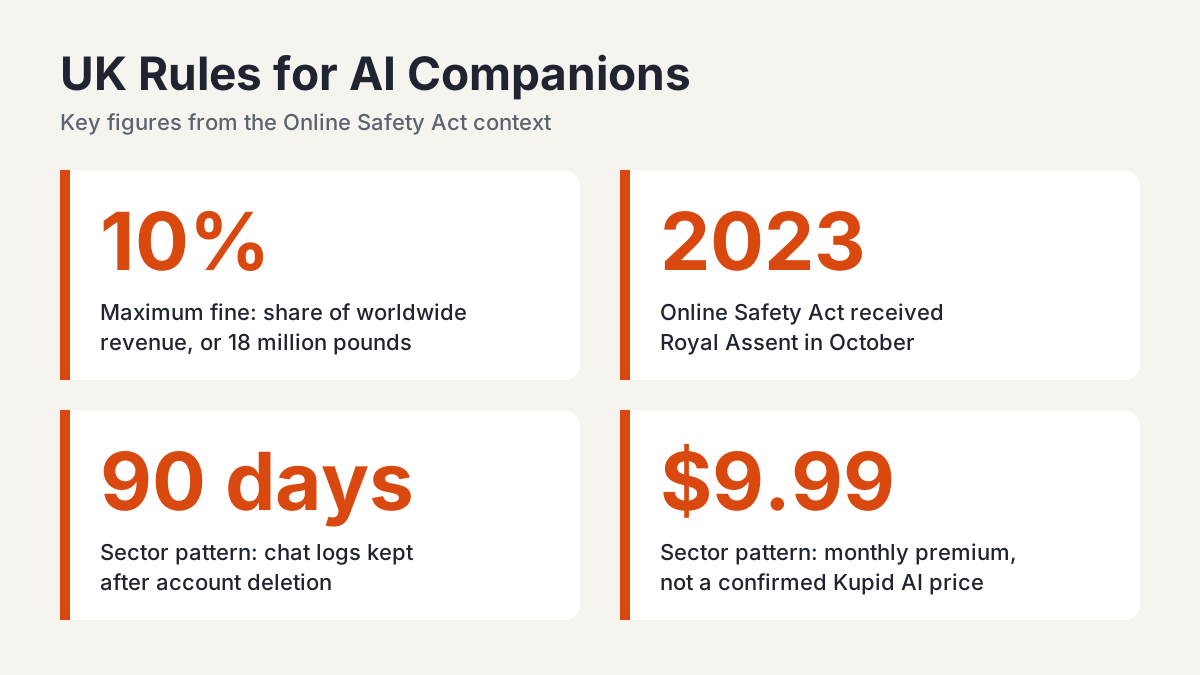
The UK has no AI-specific statute. The House of Commons Library says so plainly: AI is regulated in the context in which it is used. For an AI girlfriend app, that context is a patchwork of the Online Safety Act 2023 (which received Royal Assent in October 2023), UK GDPR and general consumer law. Noted. This article separates what is on the record from what any provider merely claims.
What the law actually says about AI companions
Start with the gap. The government has described its approach as pro-innovation and business-friendly, and it has so far relied on existing regulators rather than a single AI act. That means no licence exists for "AI companion provider" as a category. Confirmed.
The Online Safety Act is the closest fit. It targets user-to-user services, search services and services that publish pornographic content. Whether a chat with a single AI character counts as user-to-user depends on features: can users share generated content with each other, or is every conversation private and one-to-one? Ofcom, the regulator, has to apply that test service by service. Unverified: where Ofcom would place Kupid AI. Kupid AI appears in our records as an AI girlfriend service offered through an affiliate network, and our dossier carries no confirmed company details, so nobody should assume a compliance status for it.
Age assurance is where the Act bites hardest for adult-themed services. Ofcom's guidance expects "highly effective" checks, which rules out a simple tick-box saying you are over 18. Sector notes for this category describe the common approach as a government ID plus a selfie match. Per the terms of any such service, you should be told what is stored afterwards. Read the policy first.
Which duties land on a platform like Kupid AI
Three layers matter to a user in Britain, and each has a different owner.

The Online Safety Act sets duties around illegal content, protection of children and, for adult material, strong age checks. Fines can reach 10 percent of qualifying worldwide revenue or 18 million pounds, whichever is higher. That ceiling is confirmed in the Act itself.
UK GDPR and the Data Protection Act 2018 govern the personal data a companion app collects: profile details, chat logs, voice clips, payment data. A lawful basis is required, and you hold rights to access and deletion. The Information Commissioner's Office enforces this, not Ofcom.
Consumer law covers the money side. Subscriptions, token packs and cancellation terms must be clear before you pay. Category-level notes for AI companion apps mention premium tiers around 9.99 dollars a month and token bundles starting near 4.99 dollars. Treat those as sector patterns, not Kupid AI's price list. Unverified until you see the live checkout page.
One practical point trips people up. A provider based abroad is not outside the Act just because its servers are. If a service has significant UK users, it can still be in scope. Enforcement against an overseas operator is harder, which is exactly why a user should not lean on regulation as a safety net.
What I check before I open a single chat
I started testing AI companion apps in March, mostly on my sofa in Leeds after work. The first thing I did was open the privacy policy, before I touched a chat. Two of the apps said conversations were kept for "service improvement" with no stated end date. That is a data retention question I now ask every time. Noted.
One app listed a deletion route in its help centre. I submitted a test request and got an automated reply within the hour. Confirmed: the request was received. Unverified: whether anything was actually erased. A reply is not a deletion, and no regulator hands you proof of one.
The sector notes for this category describe retention of chat logs for 90 days after account deletion, with anonymised analytics kept indefinitely. If a provider publishes figures like that, good. If it publishes nothing, that silence is the finding. An app without a clear data policy should not be trusted with anything personal, and the Online Safety Act does not change that.
Gaps the Act does not close
Regulation is strongest on illegal content and children. It is weak on the things many adults worry about with a companion app. Emotional dependence is not an offence. A chatbot that gives repetitive or odd replies is not a breach. Billing disputes go through consumer routes, and slow refunds are among the most common complaints in this category.
Mental health is another gap. Companion apps usually carry a disclaimer that the AI is not a source of medical or crisis support. That disclaimer is the provider's wording, not a legal shield, and no UK rule requires an AI girlfriend app to detect distress. Do not treat a friendly character as a safeguard.
Content filtering is also self-policed in practice. Providers say they block illegal themes, hate speech and impersonation of real people, using automated screening plus human review. Per the terms, you can usually report content through an in-app button. Whether reports are handled within the stated 24 hours is something only the provider can show. On the record, that claim is unverified for Kupid AI.
How to read a provider's compliance claims
A sensible routine takes ten minutes. First, find the privacy policy and look for data retention periods, the named controller, and a deletion route. Second, find the terms and check what it costs after month one, including auto-renewal and refund conditions. Third, look at the age verification step. If it asks for nothing beyond a birthday, ask why, given what Ofcom expects.
Then compare the marketing with the small print. A page that says "fully private" while the policy allows logs to be kept is two statements, only one of which binds the company. If you want a fuller picture of this particular service, our Kupid AI review covers features and pricing, is Kupid AI safe goes through the trust questions, and Kupid AI verification explains the age check. For a comparison from the same category, the sister title Janitor AI publishes its own UK-facing notes.
Keep your expectations realistic. The UK is not about to ban or license companion apps wholesale. It is applying old rules to a new product, and enforcement will arrive case by case. Until then, your own checks are the only control you fully hold.
Comments
No comments yet.
Leave a comment
Your email will not be shown. Comments are reviewed before they appear.