


The terms of service on kupid.ai say the company reserves the right to update or make changes "from time to time in our sole discretion", and that it may notify you of changes. Two words matter there: "may" and "sole discretion". Noted. The privacy policy carries a date of 5 February 2023 in its search listing, which tells you the document exists and has an age. It does not tell you what changed.
What the terms actually promise about changes
Read the clause slowly. The company can edit the terms whenever it likes. Notification is optional, not guaranteed. Continuing to use the service after an edit normally counts as acceptance, which is standard wording for apps of this type, though you should confirm that against the current text rather than take it from a summary like this one.
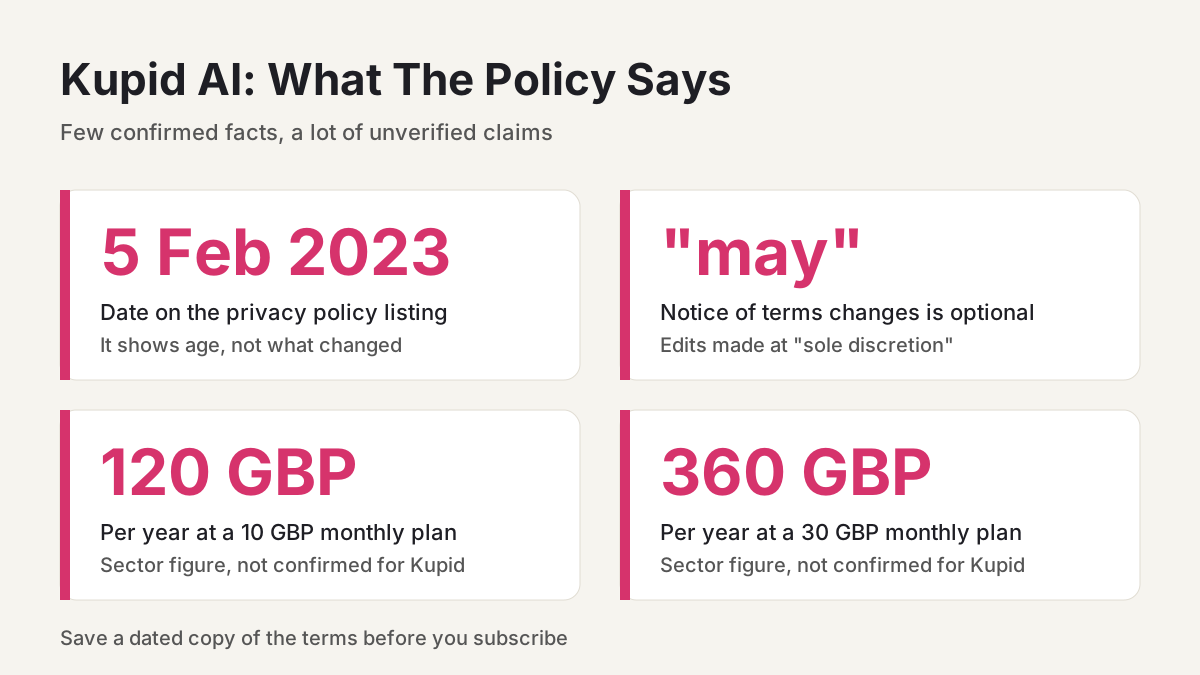
In practice, that means the version you agreed to on day one may not be the version in force today. There is no promise of a fixed price, a fixed feature list or a fixed set of content rules. If you want certainty, the only route is to save a copy of the terms with the date you read them. A screenshot or a printed PDF is enough. Without it, you cannot show later what the wording was at the time you signed up.
Unverified: whether Kupid AI publishes a dated archive of earlier terms. We did not find one. If the operator has one, it is not linked where a normal user would look, which is worth knowing in itself.
Where changes tend to bite: content rules
For AI companion services, content rules are the area that shifts most often. Operators tighten filters after a complaint, a payment processor warning or a regulatory nudge, and loosen them again when users leave. Kupid AI has no public change log that we could find, so any claim about a specific filter being added or removed on a specific date is unverified.

What the wider sector does is documented. Services in this category typically prohibit illegal content, hate speech, non-consensual themes and impersonation of real people. They usually screen prompts before generation and review output afterwards, with a report button and a warning, suspension or ban ladder. Whether Kupid AI follows each of those steps is not confirmed by anything we could check, so treat the list as the sector norm, not as a statement about this app.
Here is a test you can run yourself. Open a fresh chat, ask for something that sits near the edge of the stated rules, and see how the app responds. Write down the date and the exact reply. If the same request behaves differently a month later, you have your own evidence of a change, which is more reliable than a forum rumour.
Age checks and what the policy says about them
On a wet Tuesday in Bristol, around nine in the evening, I read the terms of an AI girlfriend service line by line. The section on age verification was a single sentence and relied on a self-declared date of birth. I tested it with a dummy account and was never asked for anything further. Unverified whether that meets the standards expected under UK rules, so I flagged it in my notes and moved on.
That was a different service, and I am not claiming Kupid AI behaves the same way. The point is the method. Check how the sign-up flow treats your age, then check what the policy says about it. If the wording promises document checks and the flow asks only for a birthday, that gap is worth recording. Services in this sector sometimes describe an ID and selfie process, with the ID deleted after the check and only the result stored. Whether Kupid AI does that is not confirmed.
Pricing: what to write down before month one ends
Price changes are the policy change most people notice, because they hit the card. Subscription tiers across the sector commonly run from a free plan with limited messages to a premium plan at around 10 pounds a month and a top tier near 30 pounds, with token packs on the side. Those are sector figures, not Kupid AI's confirmed prices. Unverified for this brand.
Do the arithmetic yourself. A plan at 10 pounds a month costs 120 pounds over twelve months. A plan at 30 pounds costs 360. If tokens expire after a stretch of inactivity, as some services state in their terms, unused balance is money you cannot get back. Read the clause on expiry and the clause on refunds before you buy a pack, not after.
Also check what happens to your plan if the price rises. Does the new price apply at the next renewal, or immediately? Can you cancel without a penalty, and where is the cancel button? Per the terms, the answer to each should be in writing. If it is not, that is your answer.
Data retention and the privacy policy
Terms and privacy policy are two separate documents, and a change in one can hide in the other. The privacy policy is where data retention lives: how long chat logs are kept, whether they are kept after you delete the account, and who receives them. Some services in this category keep logs for around 90 days after deletion and keep anonymised analytics indefinitely. Again, that is a sector pattern and not a confirmed Kupid AI figure.
Here is what to look for on a re-read. First, the retention period, as a number. Second, the deletion route, meaning whether you can delete from account settings or must email someone. Third, third-party sharing, and whether it is tied to consent. An app without a clear data policy should not be trusted with intimate conversations, full stop. If any of these three is vague, say so in your own notes and weigh it.
For wider context on how users have rated the service, our Kupid AI review collects what we could confirm, and the page on Kupid AI complaints covers billing and behaviour issues that tend to follow a policy change.
A simple routine for tracking changes yourself
Because no public change log was found, build your own. It takes ten minutes once and five minutes each quarter. Save the terms, the privacy policy and the pricing page as PDFs on the day you sign up. Name the files with the date. Every three months, open the live pages again and compare headings and numbers. You do not need software for this; a side-by-side view of two windows works.
When something has moved, write one line: what changed, where, and the date you noticed. If it affects what you pay or what happens to your chats, contact support in writing and keep the reply. On the record beats memory every time. And if the answer you get is vague or never arrives, that tells you how the operator treats its own rules.
One caution about third-party roundups. Pages that list alternatives sometimes tell you to keep a shortlist so you can compare quickly if a price rises or a policy updates. That advice is sound, but the roundup itself rarely says what changed and when. Treat it as a prompt to check, not as evidence.
Comments
No comments yet.
Leave a comment
Your email will not be shown. Comments are reviewed before they appear.