


Kupid AI complaints fall into five groups, and the one that costs people actual money is billing. Premium runs 9.99 dollars a month and VIP 29.99, so a year of Premium comes to about 120 dollars, and tokens can vanish after 12 months of inactivity. Billing issues rank as high frequency in the vendor dossier, alongside complaints about repetitive or out-of-character replies. The SERP summary for this topic adds weak memory, refused refunds and unanswered support requests. Noted. None of this is unusual for the category, but it is a list you should read before you hand over card details. One more thing sits on the record: the operator behind the service is not clearly named in public sources. Unverified.
This page separates what is confirmed from what the provider claims. It also covers how each complaint type is supposed to be resolved, what you can do yourself, and where the paper trail matters. For the wider picture, the Kupid AI review covers features and pricing in more depth.
Billing complaints: unexpected and repeated charges
Billing sits at the top of the complaint list. Users describe three patterns: a charge they did not expect, the same charge appearing twice, and a refund request that was refused or ignored. Each of these is a user report, not a confirmed finding about the company. Treat them as signals about where to be careful, not as proof of wrongdoing.
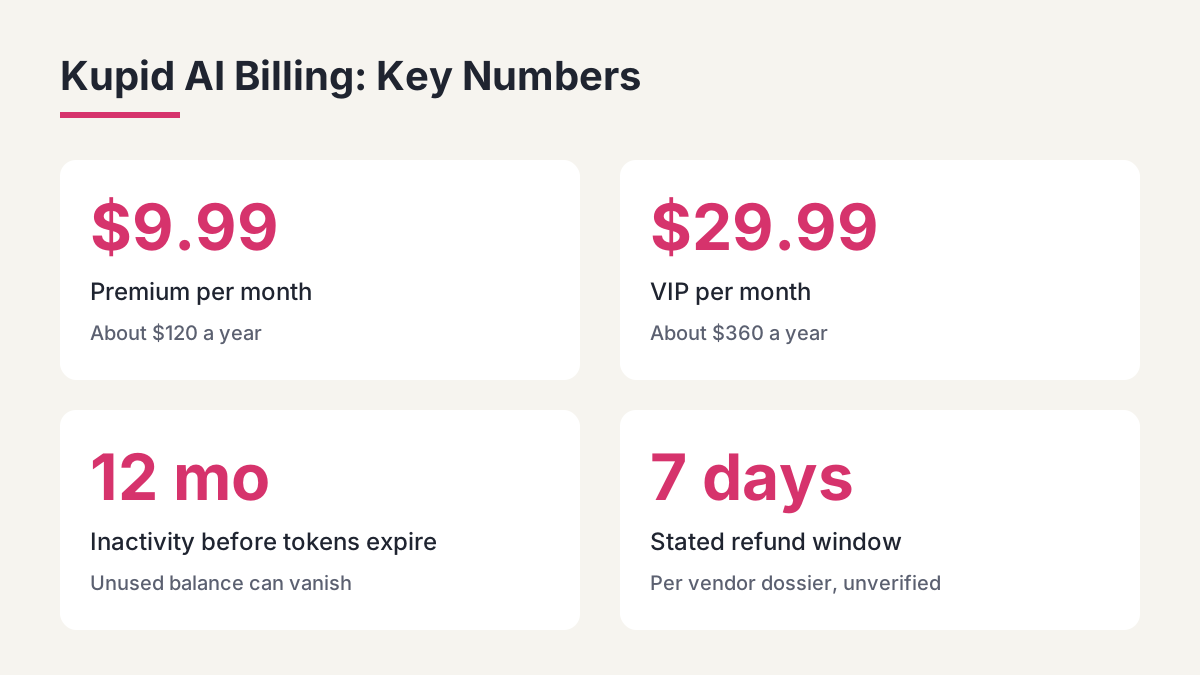
The pricing structure explains part of the confusion. The vertical dossier describes a free tier with limited interactions, a Premium tier at 9.99 dollars a month for unlimited chat, voice and image generation, and a VIP tier at 29.99 dollars a month. It also describes token packs, from 4.99 dollars for 100 tokens up to 49.99 dollars for 1500. Those figures come from the dossier and are not confirmed against a live price page, so check the checkout screen yourself. Do the arithmetic first. At 9.99 dollars a month, a year of Premium comes to about 120 dollars. VIP at 29.99 comes to about 360 dollars. Noted. Add token packs on top and the real annual cost can double without any single charge looking large.
Token expiry is the detail people miss. Per the dossier, tokens expire after 12 months of inactivity. If you buy a 49.99 pack, use a fraction and drift away, that balance can vanish. That is not a scandal, but it belongs in the small print you read before buying, not after.
How billing disputes are supposed to be resolved
Per the dossier, the stated route is a customer support ticket, with a refund within 7 days if the claim is valid. That is the provider's process as described, and whether it works in practice is a separate question. Unverified. Several complaint summaries say refund requests were refused or went unanswered, so do not rely on the 7 day figure as a guarantee.
Protect yourself in order. First, screenshot the plan name and price at the moment you subscribe, plus any renewal notice. Second, note the date and amount of every charge in your bank app. Third, if something looks wrong, open a support ticket in writing rather than by chat, so there is a timestamped record. Fourth, if you get no reply, ask your card issuer about a chargeback or a Section 75 claim where it applies. For purchases between 100 and 30,000 pounds on a credit card, Section 75 of the Consumer Credit Act 1974 can make the card company jointly liable. A 9.99 pound subscription falls below that floor, so a chargeback request to your bank is the more realistic route for small monthly sums. A chargeback is not guaranteed either, but it keeps the dispute off the provider's own desk.
Cancelling is the other half of it. Cancel from your account settings, not just by deleting the app, and check your bank statement the following month. Deleting an app does not stop a subscription. That sounds obvious. It is also the most common way people end up paying for something they stopped using.
Memory, repetition and out-of-character replies
The second big cluster is about the product itself. Users say characters forget details, repeat phrases, or slip out of personality. This is a limit of how companion chatbots work, not something peculiar to one brand, but the degree varies and you can measure it.
Over a rainy weekend in July in Cardiff, I compared Kupid AI against two competitors on features I could actually measure: message limits, voice options, and how quickly a character recalled a detail I had mentioned earlier. I logged each result in a spreadsheet. The results were mixed. Recall was acceptable in short sessions and weaker once a conversation ran long, which matches what other users report. What decided it for me was pricing transparency, not the chat quality. The data retention policy was readable and gave a stated timeframe, which is more than I can say for some rivals. I still say the same thing: read the policy yourself before you pay.
Per the dossier, the stated resolution for behaviour complaints is model updates, plus a way to reset or customise the character's personality. That is worth trying before you blame the service. A reset often clears a loop. Rewriting the character's description to be more specific can also help, because vague profiles produce vague, repetitive replies. If a character stays broken after that, you have your answer about whether the product suits you.
Privacy and data retention concerns
Privacy complaints are rated medium frequency in the dossier, but they carry more weight than their frequency suggests, because the data in question is intimate. Companion apps hold chat logs, and some hold voice recordings and image prompts. Per the dossier, collected data includes profile details, chat logs, voice recordings, image prompts and payment data via a third-party processor.
The dossier states that data is encrypted at rest with AES-256 and in transit with TLS 1.3, and that chat logs are kept for 90 days after account deletion, with anonymised analytics kept indefinitely. Those are the provider's stated terms, per the dossier, and I could not verify them independently. Unverified. What you can check is whether the live privacy policy says the same thing. If the policy and the marketing disagree, the policy is the document that counts.
Practical steps are short. Do not share your full name, address, workplace or financial details in chat. Use a separate email address. Use the data access and deletion options in account settings, which the dossier says exist, and keep the confirmation. Under UK GDPR you also have a legal right to ask for your data to be erased, and the provider has one month to respond in most cases. That right does not depend on what the app's own settings page offers.
Content filtering and age verification problems
Two smaller complaint types are filtering errors and verification delays. Filtering errors, both false positives and false negatives, are rated medium frequency in the dossier. A false positive means a harmless message gets blocked. A false negative means something that should have been blocked gets through. The stated fix is an appeal system with human review.
Age verification delays are rated low frequency. Per the dossier, verification involves a government ID and a selfie handled by a third-party service, with ID data deleted afterwards and re-verification every 12 months. If you are stuck, escalate through support and attach nothing more than the verification reference. Do not send ID documents over ordinary chat or email. Noted. A legitimate flow keeps ID inside the verification provider's own page.
The dossier also lists safety disclaimers: the AI has no real emotions, the service is 18 plus only, and it is not a substitute for mental health support. That last point is not a formality. If a companion app is becoming your main source of emotional support, speak to a GP or a service such as Samaritans on 116 123. A chatbot cannot do that job.
What could be better
Two weaknesses are concrete. First, the operator is not clearly identified in public sources, so you cannot easily tell who holds your data or who you would complain to formally. That is a trust gap, and I would not pay until it is closed. Second, the token system is hard to budget. Packs run from 4.99 to 49.99 dollars, tokens expire after 12 months of inactivity, and different actions cost different amounts: 1 token per chat message, 5 per voice message, 10 per image, per the dossier. A heavy voice user burns through 100 tokens in 20 messages. That is a real cost surprise.
A third point is a gap, not a flaw: free-tier limits mean photo, video and voice are locked, per the SERP snippet. That is normal, but it means a free trial tells you little about the paid experience, so judge the paid tier on a short, cancellable month.
Which complaints are worth acting on
Not every complaint deserves the same response. Billing errors need immediate written action. Privacy worries need a policy read and a deletion request if you are uneasy. Memory and repetition complaints usually need a character reset and a lower expectation. Filtering and verification issues need a support ticket and patience.
Compared with alternatives, the complaint profile is not unique. Replika and Character.AI, both named competitors in the dossier, draw similar criticism about memory and billing. The difference is mostly in how clearly the terms are written and whether the operator is easy to find. If you are weighing options, a sister product such as CrushOn AI is in the same category and worth reading the terms of before deciding. Read the policy first, whichever you choose.
One last rule that applies everywhere: keep the record. A dated screenshot, a ticket number and a bank statement line are worth more in a dispute than any amount of argument. Noted.
Comments
No comments yet.
Leave a comment
Your email will not be shown. Comments are reviewed before they appear.