

Kupid AI is not a scam on the evidence available, but it is not a service you should trust on marketing alone. The platform's privacy terms say chat logs are retained for 90 days after you delete an account, and anonymised analytics are kept indefinitely. Noted. Those two figures matter more than any badge on the homepage.
This guide separates what is confirmed from what the provider claims, with UK users in mind. The short version: read the policy first, assume your chats are stored, and keep personal details out of them.
What data Kupid AI collects and how long it keeps it
Start with the small print, because it decides everything else. According to the terms we reviewed, the service collects profile details such as age, gender and interests. It also stores chat logs, voice recordings, image prompts and payment data. Card details pass through a third-party processor, so Kupid AI itself should not hold your full card number. Unverified, though: the processor is not named in the sources on file.
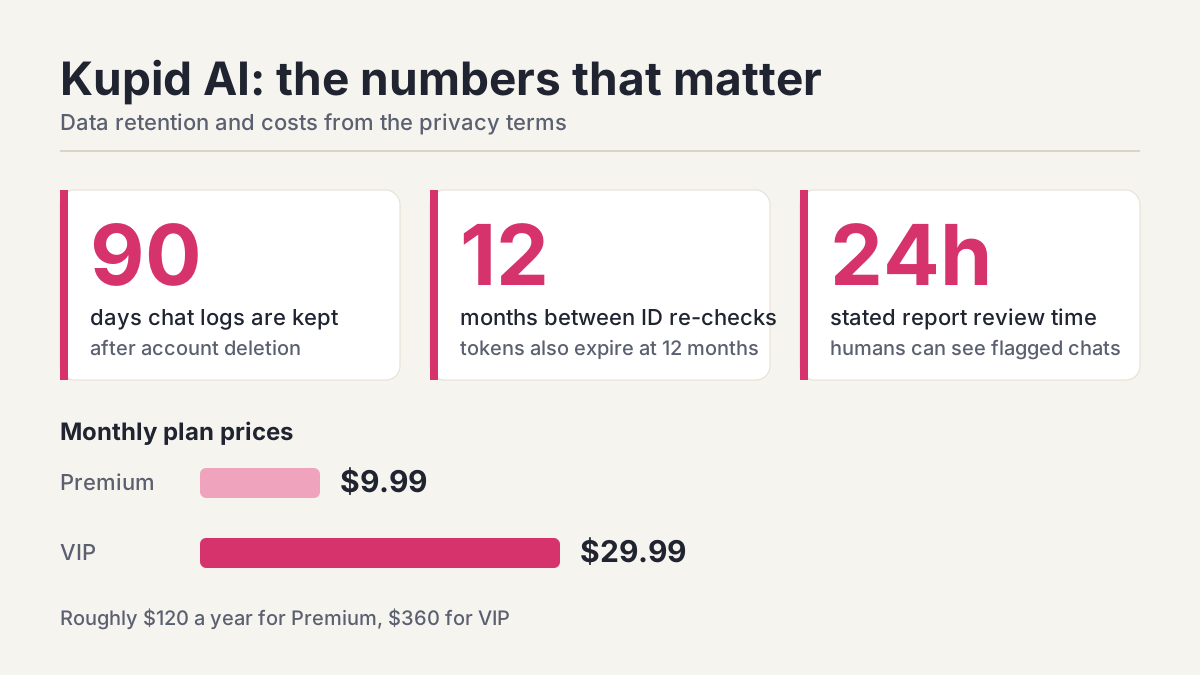
Retention is the part that surprises people. Chat logs stay for 90 days after you delete your account. Anonymised analytics have no stated end date. That means deleting the app from your phone does nothing. You have to delete the account, then wait out the 90 days.
The terms also say data is shared with third parties only with your consent for personalisation, and that aggregated data goes to research partners. Aggregated is not the same as deleted. If you would be uncomfortable with a stranger reading a conversation, do not type it. The provider says you can access, correct and delete your data through account settings, and can opt out of marketing processing. We could not confirm how long a deletion request takes in practice.
Encryption and server locations: claimed versus confirmed
The provider states that data is encrypted at rest with AES-256 and in transit with TLS 1.3, and that it sits on GDPR-compliant servers in the EU and US. Those are strong standards on paper. Unverified. No independent security audit, penetration test report or certification is cited in anything we could check.

That gap is normal for this category, but it is still a gap. Encryption protects against interception and stolen disks. It does not protect you from the company itself reading stored chats, or from a breach of the application layer. A US server location also means your data may leave the UK. Under UK GDPR, that transfer needs a lawful mechanism, and the policy should say which one it uses. Look for that line before you sign up.
One practical check takes two minutes. Open the privacy policy and search for "international transfers", "retention" and "data controller". If any of the three is missing or vague, that tells you something. A service with no named controller and no contact address for data requests is hard to hold to account. Our full Kupid AI review covers the product itself; this page stays on data.
Age verification and content rules
Kupid AI is for adults only. The stated method is a government ID upload plus a selfie matched against it, handled by a third-party verification provider. The terms say the ID image is deleted after the check and only your age and verification status are stored. Re-verification happens every 12 months or after suspicious activity.
That is a heavier process than a simple date-of-birth box, and it is reassuring on the underage side. It is also a privacy cost: you are handing over an ID document to a company you have just met. Confirmed in the terms is the deletion promise. Not confirmed is whether the verification vendor keeps its own copy under its own policy. Read that second policy too.
On content, the platform prohibits illegal material, hate speech, non-consensual themes and impersonation of real people. Text is scanned before generation using keyword and semantic analysis, and again afterwards by automated classifiers and human moderators. Reports are said to be reviewed within 24 hours. Note what that implies: humans can see flagged content. Your chats are not purely between you and a model.
What it costs, and why billing is part of safety
Money problems are the most common complaint in this category, so billing belongs in a safety guide. The dossier lists a free tier with limited interactions, a Premium plan at 9.99 dollars a month and a VIP plan at 29.99 dollars a month. At those figures Premium comes to roughly 120 dollars a year and VIP to roughly 360. Genuinely a number to write down before you start.
Tokens add another layer. A pack of 100 tokens costs 4.99 dollars, 500 cost 19.99 and 1500 cost 49.99. A chat message costs one token, a voice message five and an image ten. Do the sum: ten images eat 100 tokens, a full small pack. Tokens also expire after 12 months of inactivity, so a big pack you stop using is money lost.
In May I tried the service as part of a wider comparison of companion apps. I signed up on a Thursday afternoon from a café in Edinburgh and read the pricing page twice. The free tier was clear. The subscription renewal wording sat in a separate document, so I opened it beside the sign-up screen and compared the two line by line. That is the habit I would recommend. A cancellation clause you only find after paying is a safety problem, not a design quirk. I judged the service on what I could observe and on how open the billing was, not on claims about response quality.
For UK users, a card payment gives you a chargeback route through your bank if a charge is wrong. The terms say valid refund requests are settled within 7 days after a support ticket. Treat that as the provider's claim until you have tested it.
What could be better
Several weaknesses are concrete. First, retention: 90 days of chat logs after deletion is long for text this intimate, and the anonymised analytics have no expiry. Second, there is no named audit. Encryption standards are asserted, not evidenced. Third, tokens expire after 12 months, which punishes light users who buy a large pack. Fourth, the ID and selfie step creates a second data trail with a vendor the sources do not name.
Fifth, the complaint pattern for this kind of service is consistent. Billing disputes and repetitive or out-of-character AI behaviour rank high, while privacy worries and filter errors rank medium. Skip the VIP tier until you have used the free one for a fortnight. Would I put a real name, workplace or address into any chat? No. Those details are exactly what a retained log makes permanent.
None of this makes the service unsafe to try. It makes it a service where you set the limits, because the provider's limits are generous to the provider.
Safe-use steps for UK users
Use a separate email address and a nickname rather than your real name. Pay by credit card, not a debit card or bank transfer, so Section 75 and chargeback options stay open. Set a calendar reminder for the day before any renewal. Screenshot the cancellation page on day one.
Do not share financial details, medical history or identifying photos. The platform itself warns that the companion has no real emotions and is not a source of mental health or legal advice. If you are in crisis, speak to a professional or call Samaritans on 116 123. Use a password you do not reuse elsewhere and turn on any two-factor option offered.
If you decide to leave, delete the account rather than the app, then diary the 90-day mark. After that date, send a written data request asking the company to confirm what remains. In the UK you can complain to the Information Commissioner's Office if a reply is missing or unsatisfactory. Similar services such as Janitor AI have their own policies, so compare retention terms rather than assuming they match.
How Kupid AI compares on privacy
The table below uses the dossier's competitor list and what is confirmed in Kupid AI's own terms. Competitor cells are marked unverified where no source is on file.
| Criterion | Kupid AI (per the terms) | Typical alternative |
|---|---|---|
| Chat log retention after deletion | 90 days | Unverified, check the policy |
| Age check | ID plus selfie, re-checked every 12 months | Often a date-of-birth box only |
| Independent audit cited | None found | Unverified |
Comments
No comments yet.
Leave a comment
Your email will not be shown. Comments are reviewed before they appear.