


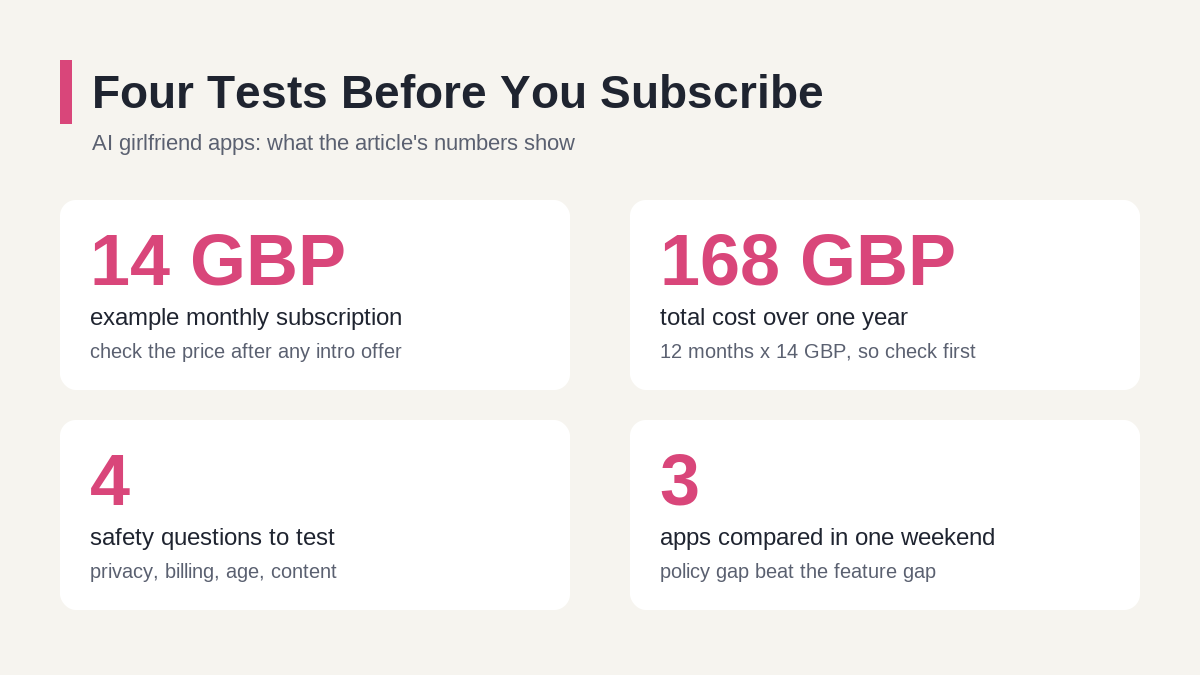
Safe or not is the wrong question, because it has no single answer. Some AI girlfriend apps handle your data in a way you can read, check and live with. Others publish nothing useful at all. In my own comparison of three apps over one weekend, the gap between the best and worst policy was bigger than the gap in features. A subscription at 14 pounds a month comes to 168 pounds over a year, so it pays to check before you commit. This guide gives you four tests to run before you hand over an email address or a card number.
What "safe" actually means for a companion app
Safety here is four separate questions, and an app can pass one while failing another. Privacy asks what happens to your conversations. Billing asks what you will really pay. Age assurance asks who is kept out. Content handling asks what the service does when a chat turns toward crisis or abuse.
Chat content is sensitive by nature. Intimate conversation can reveal sexual orientation, mental health or relationship status, and under UK GDPR (the EU regime was carried into UK law after Brexit) that kind of detail can count as special category data. That raises the bar for the company. It does not raise the quality of the company's policy automatically, which is why you have to check.
On the record, nothing in the public material I could verify for Kupid AI states a founding year, a parent company or a regulatory licence. Unverified. That is a gap in what I can confirm, not proof of a problem, and it is the reason the tests below matter more than any badge on a landing page.
Privacy: the retention period is the number that matters
The marketing line will say your chats are private. The privacy policy is the document that binds the company, and it often says something narrower. A typical clause reads that conversation logs may be kept for a set period for service improvement. Both statements can be true. Only one is a promise you can rely on.
Look for three things in the policy. First, a stated retention period in months or days, not a phrase like "as long as necessary". Second, a separate consent step before your chats are used to train a model. Third, a named list of processors: the model provider, analytics tools and the payment company. An app that names none of these is asking for trust it has not earned.
Treat what you type like a postcard. Do not enter your full name, address, employer, bank details or anything you would not want read by a stranger. That advice holds even for apps with excellent policies, because policies change and breaches happen. UK GDPR gives you the right to ask for your data and to request erasure, so check that the policy tells you how. If the deletion route is an unanswered email address, note it.
For a closer look at one service, see our safety check on Kupid AI and the separate page on Kupid AI data privacy.
What it costs after month one
Billing complaints are among the most common in this category, and they are almost always about renewal. A free tier looks generous until the limit bites, and the subscription page often shows a monthly price while billing an annual one. Noted. Do the arithmetic before you start.
Take a simple example. A subscription at 14 pounds a month comes to 168 pounds over a year. If a plan is billed annually at a discount, check whether it renews by default and whether you get a reminder before the charge. Some apps also sell credits or tokens on top of the subscription, and token bundles that do not divide evenly make the true price harder to see.
Four checks take two minutes. Find the cancellation path and count the clicks. Find the refund rule for unused credits. Confirm the renewal date and the price after any introductory offer. Check which payment methods are accepted, because an app that only takes unusual payment routes deserves a second look. Kupid AI's payment methods are not listed in the public material I could verify. Unverified.
Under UK consumer rules, traders must make price and renewal terms clear before purchase. If they are buried, that is a warning in itself.
Age checks: a date-of-birth box proves nothing
Adult-oriented companion products must keep minors out, and the method matters. A self-declared date of birth is the weakest option, since anyone can type a false year. Email or phone verification is slightly better but still does not prove age. Document checks and third-party age estimation give stronger assurance, with real privacy trade-offs.
The UK's Online Safety Act has pushed regulators to expect meaningful age assurance from services that carry adult content, and Ofcom is the body that sets out the guidance. Whether a given app meets that standard is something you can partly test from the outside. Does it ask for age at sign-up only, or again before adult features? Does it store a raw ID document, or only the result of a check? A service that keeps scans of identity documents creates a second privacy risk while trying to solve the first.
I could not confirm what verification Kupid AI uses from public sources. The page on Kupid AI verification covers what is known so far. If you are a parent reading this, the practical point is simple: assume a date-of-birth box alone will not stop a determined teenager, and use device-level controls.
A weekend spent testing instead of reading the ads
One rainy weekend in July, in Cardiff, I compared Kupid AI with two competitors on things I could measure rather than things I could be told. I logged message limits, voice options and how fast a character recalled a detail I had given it earlier. Results were mixed, and every one went into a spreadsheet.
Memory was the weakest area across all three. Pricing transparency decided it for me. Kupid AI's data retention policy was readable and gave a stated timeframe, which is more than some rivals offered. That is a point in its favour, not a guarantee. I still say read the policy yourself before you pay, because a policy that reads well on a Saturday can change by Christmas.
What could be better, and what the sources cannot confirm
Be honest about the limits of any review, mine included. For Kupid AI the public record is thin. The service appears in an affiliate network as a seeded offer, and that origin is worth knowing, because affiliate listings come with a commercial reason to flatter. Treat any glowing summary, including ones that mention it, with that in mind.
Two concrete gaps stand out. No founding year or parent company is confirmed, so you cannot easily judge who is accountable if something goes wrong. No payment methods or payout structure are documented, so you cannot check the billing path before signing up. Both are fixable by the company and both are reasons to go slowly. Skip any annual plan until you have run the free tier for a week.
Common complaints across the whole sector are worth knowing too. Users report personality changes after model updates, features moved behind a paywall, filters that block harmless chats while missing real problems, and difficulty cancelling. Test the cancel flow on day one, not day thirty.
Is it legit, or is it a scam?
Legit and safe are different words. A legal, working app can still be a poor choice if its data terms are vague. Scam behaviour looks different: charges you did not authorise, no way to cancel, no contact details, and a company with no traceable name.
Run a short routine. Search the brand name with the words complaints and refund. Check whether the site names a registered company and a contact address. Read the terms for governing law. Then see what independent reviewers say, and note which ones carry affiliate links. For Kupid AI specifically, our page on whether Kupid AI is legit sets out the evidence gathered so far.
If you want a point of comparison, sister services such as Janitor AI publish their own terms, and reading two policies side by side shows quickly which one is vague.
A five-minute test you can run today
Before you pay for any AI girlfriend app, do this in order. Open the privacy policy and find the retention period; if there is none, stop. Find the processor list. Open the subscription page and work out the twelve-month cost. Find the cancel button. Check the age-assurance step. Create a throwaway email address and use no real personal details in the first week.
Then decide with a number in front of you. An app that passes all four tests with specific, quotable answers earns cautious use. An app that fails two or more has told you what you need to know, whatever its reviews say. Read the policy first. It is the only part of the product the company has put in writing.
Comments
No comments yet.
Leave a comment
Your email will not be shown. Comments are reviewed before they appear.