

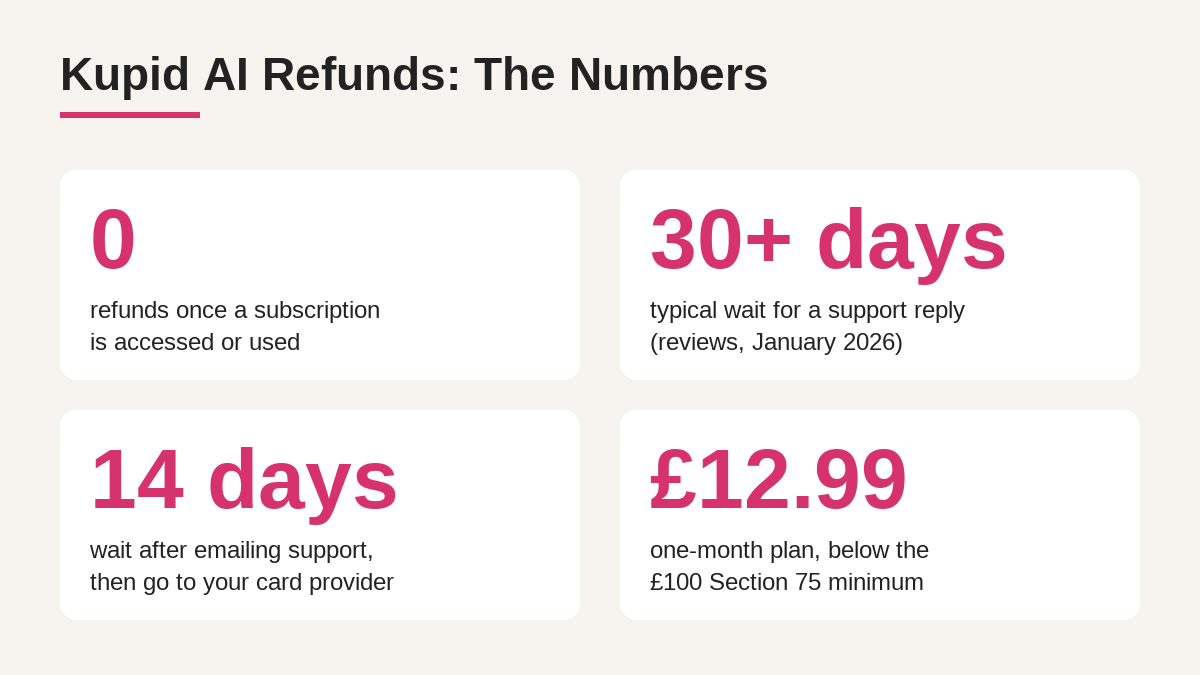
The verdict: Kupid AI does not give refunds, and its own Terms of Service say so in plain words. They state that there are no refunds, returns or cancellations for subscriptions accessed or used after purchase. A cancellation guide published on 7 November 2024 repeats the same strict no-refund line. So do you actually want to pay for this without a safety net? Think about that before you tap buy.
That does not mean you are powerless. It means your route to getting money back runs through goodwill, your card provider or UK consumer law, not through a refund button. The sections below take each route in order, from cheapest effort to most effort.
What the Kupid AI refund policy actually says
The wording sits in the Terms of Service, and it is blunt. No refunds, returns or cancellations for subscriptions that have been accessed or used after purchase. Coins and virtual currency get their own section in the same document, and you should read that part before spending anything on in-app currency, because virtual currency is normally treated as spent the moment you buy it.
Notice the phrase "accessed or used". It is the hinge of the whole policy. If you pay and then never open the app, you have at least an argument. If you chat for ten minutes, the company will say the service was used. That is the trade-off with any subscription you can start instantly: the second you use it, the clock on your refund rights is treated as stopped.
There is also no native app on iOS or Android to lean on for store-level refunds in the way you would with a typical app, so you cannot assume Apple or Google will step in. Check where your payment actually went before you plan your next move.
How to request a refund anyway
Ask in writing, and ask fast. Support replies are slow. Customer reviews published in January 2026 note that replies typically take over a month, so a request sent on day 25 of a billing cycle can easily arrive after the renewal date has passed. Do not wait.
Follow this order:
- Cancel the subscription first, so you are not billed again while you argue about the last charge.
- Email support with the date of purchase, the amount, the last four digits of the card and a one-line reason. Keep it factual.
- Say whether you used the service. If you did not, say so clearly, because it is your only real lever against the "accessed or used" clause.
- Screenshot the confirmation page and the charge on your bank statement.
- Set a diary reminder for 14 days. If nothing arrives, move to your card provider.
Skip the angry tone. A support agent with discretion helps polite, specific requests first. Our guide to Kupid AI complaints covers what other users report about response times and outcomes.
My own test: what one month cost me
On a rainy Tuesday in November I paid 12.99 pounds for a one-month subscription to a companion app and spent an hour on it from my sofa in Cardiff. The chat was quick. The voice add-on was extra, not part of the base price. I would not have asked for my money back, because I got what the base plan promised. But if voice had been the reason I bought, I would have felt misled, and under a no-refund policy that feeling gets you nowhere. Worth the money? Only for the chat. Read exactly what the base price includes before you pay, because afterwards it is too late to argue.
Your UK rights when the policy says no
A company can write "no refunds" in its terms, but it cannot contract out of UK consumer law. If you were charged for a service that was not delivered, was charged after you cancelled, or were billed an amount you never agreed to, you have grounds that no policy overrides. The Consumer Rights Act 2015 requires digital content to be of satisfactory quality and as described, and a charge you did not authorise is a separate matter altogether.
The practical tool is your card provider. If you paid by credit card and the amount is between 100 and 30,000 pounds, Section 75 can make the card company jointly liable, but a 12.99 pound subscription falls below that floor. For small amounts, ask your bank for a chargeback instead. Chargebacks are a card-scheme process, not a legal right, and success is not guaranteed, but they work often enough on duplicate or post-cancellation charges to be worth a call.
Be honest with yourself about the strength of your case. "I changed my mind" is weak. "I was billed twice" or "I cancelled on the 3rd and was charged on the 10th" is strong. Evidence beats frustration every time.
What could be better
The weak points are concrete. First, the no-refund stance has no stated exception for accidental purchases or technical failure, which is harsher than many rivals. Second, support is slow: a typical wait of over a month, according to reviews dated 8 January 2026, means any time-limited remedy can expire before anyone answers you. Third, coins and virtual currency are treated as consumed on purchase, so unused balance is not recoverable. Fourth, the voice and similar extras are priced separately, which makes the headline price a poor guide to the real cost. That is poor value if you expected everything in the base plan.
Refund options compared
| Route | Best for | Likelihood |
|---|---|---|
| Support goodwill request | Unused service, recent charge | Low, slow reply |
| Card chargeback | Duplicate or post-cancellation charge | Moderate with evidence |
| Consumer Rights Act claim | Service not as described | Moderate, needs proof |
Ruling: cancel early, ask politely once, then go to your card provider if the charge was wrong. If you just got buyer's remorse, skip the refund hunt and learn from it.
Comments
No comments yet.
Leave a comment
Your email will not be shown. Comments are reviewed before they appear.